If your athlete fades early in games or struggles to bounce back after hard practices, they may be under-fueled.
Often the missing piece is carbohydrates, the body’s main fuel for high-intensity work. You cannot play fast late in the game on an empty tank.
Why do carbs matter so much in water polo?
Carbohydrates break down into glucose, which your muscles store as glycogen. Glycogen fuels the hardest parts of the game:
- Sprints on the counterattack
- Nonstop eggbeater
- Explosive shots and blocks
- Focus and reaction time in fast possessions
"I used to eat super clean, but I was eating too little, especially not enough carbs. Once I added more pasta, potatoes, and fruit into my routine, I felt a huge difference. I had more gas in the tank at the end of games and could play harder for longer."
Balazs Berenyi, Fordham University water polo, three-year starter and two-time MAWPC Defensive Player of the Week
What happens when a player does not eat enough carbs?
- Glycogen runs low and energy fades early
- Legs feel heavy in the third and fourth quarters
- Decisions slow down and defensive reads suffer
"The difference between playing well for two quarters and dominating the whole game comes down to how I eat the day before and the day of. Carbs are everything for that. If I skip them, I feel flat. If I fuel up right, I can close games strong."
Balazs Berenyi
How many carbs does a water polo athlete need?
The joint position of the American College of Sports Medicine, the Academy of Nutrition and Dietetics, and Dietitians of Canada sets daily carbohydrate targets by training load:
| Daily training | Carbs per kg of body weight | For a 64 kg (140 lb) athlete |
|---|---|---|
| Light, skill-based work | 3 to 5 g/kg | 190 to 320 g |
| About 1 hour of hard training | 5 to 7 g/kg | 320 to 450 g |
| 1 to 3 hours of hard training | 6 to 10 g/kg | 385 to 640 g |
For reference, a cup of cooked rice has about 45 grams of carbohydrate, a medium banana about 27 grams, and a cup of cooked oats about 27 grams. Athletes with medical conditions or weight goals should work with a registered sports dietitian.
Which carb foods support performance?
- Whole-grain pasta and rice
- Potatoes and sweet potatoes
- Oatmeal
- Bananas and oranges
- Beans and lentils
- Whole-grain bread and wraps
- Milk and yogurt
Examples: a banana and granola bar before practice, pasta with marinara and chicken the night before a game, or chocolate milk and a turkey sandwich after training.
Why do low-carb diets backfire for young athletes?
Keto and low-carb plans may appeal to adults trying to lose weight. They do not match the needs of growing athletes in a high-output sport.
"At one point I tried cutting back on carbs because I thought it would help with weight. I had zero energy in practice. I was not playing like myself. It took me one bad weekend to realize how important fueling really is."
Balazs Berenyi
How can parents make sure athletes get enough carbs?
- Breakfast: oatmeal or toast with fruit
- Lunch: a sandwich or wrap plus fruit
- After school: yogurt and granola, or crackers and cheese
- Dinner: pasta, rice, or potatoes with lean protein
If your athlete is often tired, irritable, or fading late in games, look at carbohydrate and total food intake first.
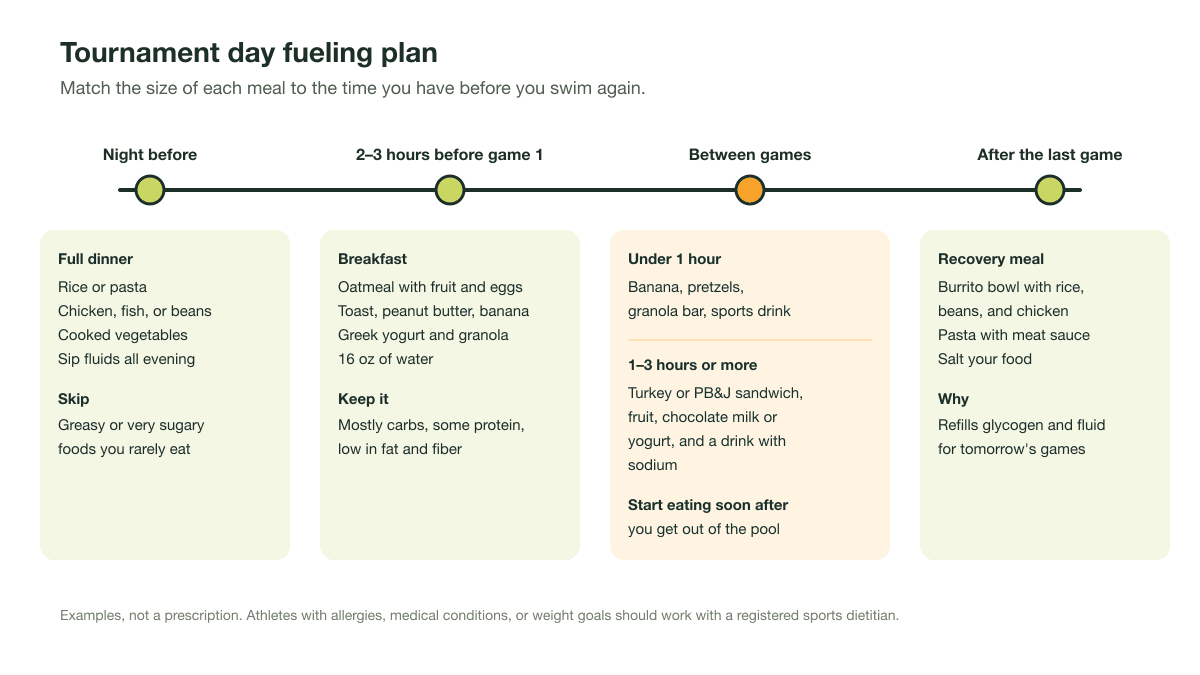
Carbs work best with smart hydration. Read the hydration guide, the tournament fueling plan, and the complete water polo nutrition guide.
Need direct help with nutrition planning?
Book a free call with our team, or bring your questions to a live nutrition session on our sessions calendar.